Tuesday, November 29, 2011

Meking Corona 250T strobe flash light test & review

I was looking for a couple of inexpensive monolight for my niece. She sells vintage clothing on the net and needed a lighting setup to photograph her items. The Corona 250T sold by Meking Equipment (also listed as Meking Studio) looked like the ideal solution. Unfortunately it does not come close to meet Meking's advertised specifications. Both the wattsecond and guide number listed is more than double what the unit actually puts out.

The 250T is the lowest power monolight in the Corona series. In addition to the 250T there also is the Corona 350T and the Corona 450T. One initial note on this monolight. While the specifications lists that a 120 volt version Meking only sells the 220 volt versions individually. But they do have an Ebay listing for a kit that includes two 450Ts and a 250T for 120 volts. Odd.

Jan 2012 Edit: - The following is the specifications claimed by Meking. From my examination and test on the 250T the power and guide number stated is completely fiction. It is not even remotely close to what the the unit produces. I have repeatedly asked Meking for clarification and they keep stalling.
Corona250T350T450T
Power Range250ws350ws450ws
Power ControlVariableVariableVariable
Guide No. 50GN58GN66GN
Recycle Time0.8-1.5s0.8-1.5s1-2s
Continues Lamp100ws100ws100ws


The primary thing that attracted me to this flash unit is that the reflector can be removed and it can be operated in bare bulb mode. This is desirable when using a flash/strobe in a softbox. With the bare bulb a lot of the light is reflected off the sides before being reflected into the diffusion layers. So one big plus for the Corona 250T.

Sunday, October 16, 2011

Small softbox diffuser comparison

In this post I will be testing a couple of small hot-shoe flash softboxes. Initially I had intended this to be on the inflatable diffuser at the top left. But before I completed this entry I received the 7"x11" diffuser on the right. So I re-shot the setup including that item. I compared the results of those two diffusers to a couple of umbrellas, one silver and the other a white reflective. 


So I thought I was done but then I received a 20"x27" cheap Ebay softbox, so I included it as it cost only $15 and some sites sell the 7x11 diffuser for tha amount (but typically $10). And then at the last minute I decided to also include the LumiQuest Pocket Bounce shown at the bottom left. Talk about project creep!

Thursday, April 7, 2011

Vintage Clothing photo shoot 2

Another photo shoot but only with the talented and lovely Emilie this time. This shoot was for clothing to be sold at Shoplimbs.com an online vintage clothing store.


Tuesday, January 11, 2011

Cactus V5 review, radio flash trigger by Gadget Infinity

Harvest One Limited, through their Gadget Infinity web store, have been widely known for their Catus brand of radio triggers for "Strobist" use. The Cactus triggers were (are) an inexpensive way to get into off camera flash triggering with radio triggers. The earlier versions operated well enough under many limited range conditions but could sometimes be less reliable than desired. They also could be subject to radio frequency interference from newer flash designs that didn't want to play nice, like the Canon EX series. The basic design went through a number of changes and new models were released in order to address the reliability issue along with making the product more user friendly. While improvements were made the electronic design was basically the same but tweeked with every new version up until now.


The Cactus V5 trigger is a completely new design. Where the previous versions operated on 433MHz radio frequency the V5 uses the 2.4GHz band. Radio triggers that used the 433MHz band could experience interference and false triggering when used with RF noisy flashes. This could limit the already short range of operation for these triggers. In extreme cases (false triggering) they just couldn't be used. So the logical solution to the problem is to move to a frequency band that these noisy flashes don't radiate in. This is one of the reasons most of the recent triggers are now using the 2.4GHz band.

Thursday, December 9, 2010

Vintage clothing fashion photo shoot

I did a photo shoot for an online vintage clothing store called shopLIMBS. The requirements were for clean simple images that show the clothing for sale. Shots were to be a front, side and back view. Also closer shots to show specific detail. There were 30 items to photograph.


So I decided to go with a white background to give a brighter cleaner look. Lighting for the models was from a 60" reflective white umbrella to my right and a 60" shoot through umbrella to my left. One flash head on a boom high up lighting the upper part of the background. And two Canon 580EXs lighting the lower half and sides of the background. All radio triggered.

A couple of reflectors were used as gobos keeping the key and fill light from shining into the camera lens.

Tuesday, October 26, 2010

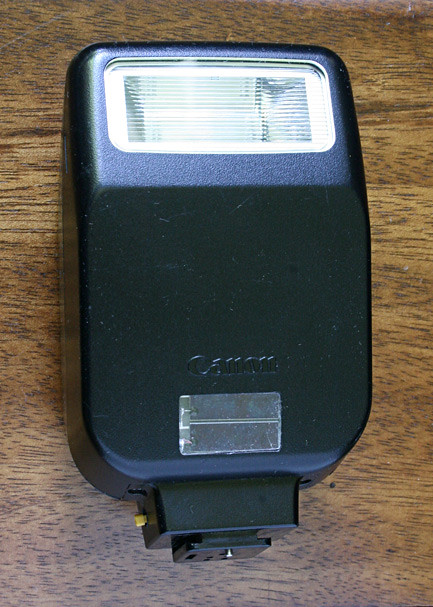
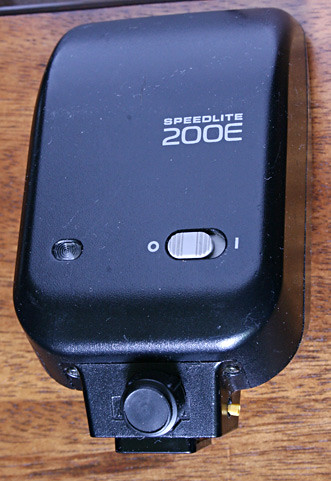
Adding manual power control to the Canon 200E

So what do you do with an old flash with no manual power control? You modify it of course.

Not such a big deal if the flash in question has an Auto mode sensor, just replace the sensor with a logrithmic pot. But if it is a TTL only flash then you have a lot more work.

In 1990 Canon released a small hotshoe mount flash the 200E. As bare bones as you can get. Controlled by A-TTL only.

It has a power switch to turn it on and a ready light to tell you when it was (you guessed it) ready to fire. Nothing else for controls. It doesn't even have a test button.


While it can be used on an old A-TTL film camera but it is next to useless for off camera work. So I changed by adding manual power control, adding a test button, and an optical slave circuit. Still to come is a 1/8" jacj so it can be triggered by an RF or external optical trigger. As soon as I decide where to put it.

The top image is the front view of a modified Canon 200E flash. The focus assist light was removed and a solar cell used for optical triggering (and other parts) were added. The small yellow pin on the lower left is the new test switch.

Sunday, October 10, 2010

Community mosaic/mixed media mural

I was asked by Ursula Neufeld of Glass Garden Mosaics to take some pictures of a mural project she is involved in. The Red Road Lodge and Studio 631 (a drop in arts center) is getting a face lift. And rather than just a coat of paint the facility is getting a mixed media mural.